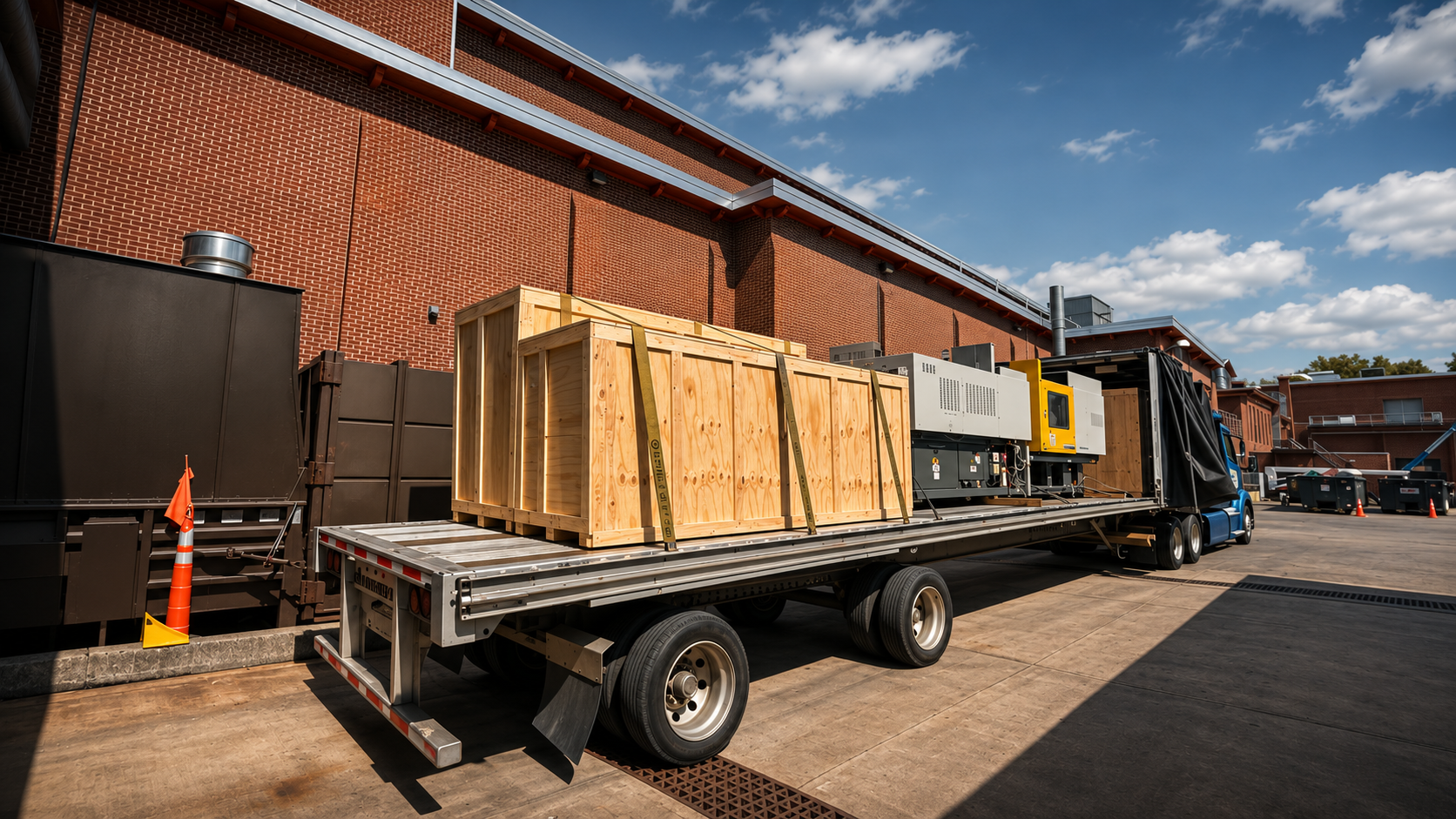
A shipment of construction materials is ready to move. The pickup and delivery locations are confirmed. But there's one important question: which trailer is actually right for the load?
Not every construction shipment requires a flatbed.
And not every load that fits on a trailer can be transported using the same equipment, loading procedures, or route.
A shipment of palletized flooring materials may be well suited for an enclosed dry van.
Structural steel beams may require an open-deck trailer with appropriate cargo securement.
A taller piece of construction machinery may need a step deck to accommodate its height.
The difference comes down to more than the type of material being transported.
Dimensions, weight, loading access, cargo protection, and delivery conditions all influence the equipment decision.
For construction companies, building material suppliers, equipment distributors, and logistics managers, choosing the right trailer is an important part of planning a successful shipment.
Here's what to consider when comparing three common transportation options: dry van, flatbed, and step deck.
1. Dry Van: When Construction Materials Need Enclosed Transportation
Dry van trailers are commonly associated with general freight, but they can also be an appropriate solution for construction materials.
A standard dry van is an enclosed trailer designed to protect freight from direct exposure to weather and road conditions.
Because the cargo travels inside the trailer, dry vans are often suitable for packaged building materials that can be loaded and unloaded through the rear doors.
What construction materials can move in a dry van?
Depending on their dimensions, packaging, weight, and handling requirements, examples may include:
Palletized flooring products.
Packaged building supplies.
Electrical components.
Plumbing materials and fixtures.
Boxed hardware.
Certain construction tools and equipment.
Packaged interior finishing materials.
For these shipments, an enclosed trailer can help protect the cargo from rain, debris, and direct exposure during transportation.
However, the fact that a material is used in construction doesn't automatically make it suitable for a dry van.
The cargo must fit within the trailer's usable interior dimensions and through its loading doors.
Loading and unloading considerations
Most dry vans are loaded through rear doors, often using forklifts at a warehouse or loading dock.
This can create challenges when delivering to construction sites without conventional receiving facilities.
For example, a jobsite may not have a loading dock or the equipment needed to unload palletized materials from a standard trailer.
In these situations, the shipper must confirm whether appropriate unloading equipment is available or whether a different transportation arrangement is necessary.
When should you choose a dry van?
A dry van may be the right choice when the freight:
Fits within the trailer and door dimensions.
Requires protection from direct weather exposure.
Can be loaded and unloaded using the available equipment.
Does not require top or side loading.
Meets the trailer's payload and weight-distribution requirements.
The main advantage of a dry van is enclosed transportation for compatible construction freight.
But when materials are too large, irregularly shaped, or difficult to load through rear doors, an open-deck trailer may be more appropriate.
2. Flatbed: When Construction Freight Requires Open-Deck Access
Flatbed trailers are widely used for transporting construction materials.
Unlike dry vans, flatbeds have an open platform without permanent walls or a roof.
This design allows freight to be loaded and unloaded from the sides or above, making them useful for materials that require forklifts, cranes, or specialized lifting equipment.
What construction materials commonly move on flatbeds?
Depending on their dimensions and securement requirements, flatbeds may be used for:
Structural steel beams.
Bundled lumber.
Steel products.
Concrete products.
Construction pipes.
Building panels.
Certain types of machinery.
Other irregularly shaped building materials.
For example, a shipment of structural steel may be difficult to handle inside an enclosed trailer.
A flatbed provides more flexibility for loading the material from above using a crane.
That accessibility can make the operation more practical at both the origin and destination.
Understanding flatbed dimensions
Standard flatbed trailers commonly have a deck height of approximately 5 feet.
Typical trailer lengths range from 48 to 53 feet, although available configurations vary.
The height of the deck matters because the cargo must remain within the applicable overall vehicle height limits unless an appropriate permitted movement is arranged.
For planning purposes, a standard flatbed may accommodate approximately 8 feet 6 inches of cargo height in jurisdictions with a 13-foot-6-inch overall height limit.
However, this is not a universal legal limit.
Actual allowable dimensions depend on the trailer, equipment configuration, route, and applicable state regulations.
Cargo securement is essential
Open-deck transportation requires careful attention to securing the load.
Depending on the cargo, the transportation plan may require:
Chains and binders.
Straps.
Dunnage.
Blocking and bracing.
Edge protection.
Appropriate tarping.
Different commodities may also be subject to specific cargo securement requirements.
For example, the Federal Motor Carrier Safety Administration (FMCSA) has established rules addressing commodities such as bundled lumber, concrete pipe, and heavy equipment.
These requirements should be evaluated according to the actual load.
What about weather protection?
Because flatbeds are open trailers, cargo may be exposed to rain, road debris, and other environmental conditions.
Tarping can provide protection for certain loads, but it does not automatically provide the same enclosed environment as a dry van.
If the materials require additional protection, the shipper should confirm whether an appropriate tarping arrangement or another trailer configuration is needed.
Flatbed transportation offers flexibility for construction materials that require open-deck loading and specialized securement.
3. Step Deck: When Construction Equipment Needs Additional Height Clearance
Step deck trailers, also called drop decks, are another common transportation solution for construction freight.
They are similar to flatbeds but have a different deck configuration.
A step deck features a raised front section and a lower main deck.
This lower deck allows certain taller loads to be transported while maintaining a lower overall loaded height than they would have on a standard flatbed.
What construction freight may require a step deck?
Examples include:
Certain excavators.
Construction machinery.
Taller industrial equipment.
Specialized building components.
Equipment that exceeds standard flatbed height clearance.
Consider a piece of construction equipment measuring 9 feet 6 inches tall.
Placing it on a standard flatbed with a deck approximately 5 feet high could create an overall height of roughly 14 feet 6 inches.
That may exceed the legal height limit on parts of the intended route.
A step deck with a lower main deck may reduce the overall height sufficiently to allow transportation under applicable limits.
However, trailer dimensions and route restrictions must still be verified.
Does a step deck eliminate the need for permits?
Not necessarily.
A step deck provides additional height clearance, but it doesn't automatically eliminate oversize or overweight requirements.
Permits may still be necessary depending on:
Overall loaded height.
Cargo width.
Overall vehicle or load length.
Gross and axle weights.
State regulations.
Specific route restrictions.
The lower deck also has its own usable length and capacity limitations.
These factors must be considered before choosing the equipment.
What about loading construction machinery?
Some construction equipment can be loaded using appropriate ramps or driven onto specially configured trailers.
Other machinery may require cranes or specialized loading arrangements.
The transportation plan should confirm the loading method, equipment capabilities, and securement requirements before dispatch.
A step deck can provide a practical solution when construction freight needs open-deck transportation with additional height clearance.
However, particularly tall or heavy equipment may require a different specialized trailer.
Flatbed vs. Step Deck vs. Dry Van: What's the Difference?
Each trailer type serves a different purpose.
Understanding those differences helps shippers evaluate transportation options before requesting a freight quote.
| Factor | Dry Van | Flatbed | Step Deck |
|---|---|---|---|
| Trailer design | Enclosed | Open, level deck | Open, lowered main deck |
| Common cargo | Packaged building materials | Steel, lumber, pipes, building components | Taller machinery and equipment |
| Loading access | Primarily rear doors | Side, top, or rear where practical | Side, top, or ramps where appropriate |
| Weather protection | Enclosed transportation | Tarping or other protection when needed | Tarping or other protection when needed |
| Height considerations | Interior and door clearance | Cargo height plus deck height | Lower main deck provides additional height clearance |
| Primary advantage | Protection for compatible packaged freight | Flexible loading of irregular materials | Additional clearance for taller loads |
The best choice depends on the physical characteristics of the freight and the requirements of the transportation operation.
Choosing equipment based only on the type of material can lead to incorrect assumptions.
The actual shipment specifications should determine the final decision.
4. Why Cargo Dimensions Matter More Than Trailer Labels
One of the most common planning mistakes is requesting a trailer before confirming the complete dimensions of the shipment.
A shipper might describe a load as construction equipment without providing its actual measurements.
But the term alone does not establish whether the equipment can move on a flatbed, step deck, or another specialized trailer.
Before transportation is arranged, the following information should be confirmed.
Length
How much usable trailer space will the shipment require?
Long materials may extend beyond standard loading configurations and may require additional planning.
Width
Does the cargo remain within the applicable width limits?
The federal width standard for commercial vehicles operating on the National Network is generally 102 inches.
Loads exceeding applicable limits may require special permits and routing considerations.
Height
What will the total height be once the cargo is placed on the trailer?
This calculation should consider the actual loaded deck height, cargo dimensions, and any protruding components.
Weight
Does the equipment have adequate payload capacity for the shipment?
Weight distribution and applicable axle limits are also important.
A load can be within the trailer's advertised cargo capacity while still creating weight-distribution concerns.
Loading configuration
Can the freight be loaded from the rear?
Does it require a forklift, crane, or ramp?
Are there designated lifting or securement points?
These details help determine whether the equipment can accommodate the shipment safely and practically.
Accurate cargo information reduces the risk of assigning a trailer that cannot handle the load as planned.
5. Jobsite Delivery Requires Additional Planning
Choosing the right trailer is only part of construction freight transportation.
The conditions at the delivery location can be equally important.
Unlike a conventional distribution center, an active construction site may have temporary access roads, restricted working areas, limited maneuvering space, or changing delivery schedules.
These conditions can influence whether a truck can reach the unloading area.
Questions to ask before scheduling delivery
Can the truck access the jobsite?
Verify entrance restrictions, road conditions, turning space, and other relevant access limitations.
Is unloading equipment available?
Confirm whether forklifts, cranes, or other necessary equipment will be onsite.
Who is responsible for unloading?
Loading and unloading responsibilities should be established before the shipment arrives.
Are there specific delivery windows?
Construction sites may restrict deliveries to particular hours or require advance coordination.
Does the site require special procedures?
Confirm any relevant check-in instructions, designated unloading areas, and site-specific requirements.
These details may appear minor during the quoting process.
But they can become significant operational challenges when the truck arrives.
A trailer that is appropriate for the cargo may still be unsuitable for the receiving location if access and unloading requirements haven't been considered.
Construction freight planning should account for both the load and the destination.
6. When Oversize or Heavy Haul Transportation May Be Necessary
Some construction shipments fall outside the practical or legal capabilities of standard flatbed and step deck transportation.
Examples may include exceptionally large machinery, heavy industrial equipment, or oversized structural components.
In these situations, specialized equipment may be required.
Depending on the shipment, transportation options can include:
Double Drop Trailers
Trailers with a lower central deck section that can accommodate certain taller loads.
Removable Gooseneck (RGN) Trailers
Specialized trailers with a detachable front section that can facilitate loading certain types of heavy machinery.
Multi-Axle Equipment
Trailer configurations designed to distribute weight across additional axles for qualifying heavy movements.
Oversize and overweight shipments may also involve:
State transportation permits.
Route planning.
Bridge and clearance restrictions.
Travel-time restrictions.
Escort or pilot vehicles when required.
These requirements vary based on the load and the jurisdictions involved.
For this reason, the transportation plan should be reviewed before dispatch rather than assuming a standard trailer can accommodate the movement.
Specialized construction freight requires equipment selection and route planning to work together.
7. How to Choose the Right Trailer for Construction Materials
Before booking a construction shipment, use a consistent evaluation process.
Step 1: Identify the Cargo
Confirm the material or equipment being transported.
Include the commodity description, dimensions, weight, packaging, and any special characteristics.
Step 2: Determine the Loading Method
Establish whether the freight can be loaded through rear doors or requires side, overhead, or ramp access.
Confirm that the appropriate equipment will be available.
Step 3: Evaluate Cargo Protection
Determine whether the shipment requires enclosed transportation, tarping, or another protection arrangement.
This is particularly important for materials that may be affected by moisture or handling conditions.
Step 4: Check Equipment and Route Compatibility
Compare the shipment's dimensions and weight against the proposed trailer configuration.
Verify whether any size, weight, or routing restrictions apply.
Step 5: Confirm Delivery Conditions
Review jobsite access, unloading capabilities, appointments, and receiving instructions.
Step 6: Verify Carrier Qualifications
Ensure the assigned carrier has appropriate operating authority, insurance, equipment, and experience relevant to the shipment.
For specialized movements, additional qualifications and transportation requirements may apply.
Step 7: Establish the Communication Plan
Confirm pickup requirements, delivery expectations, and how shipment updates will be provided.
This is especially important when materials are moving according to a construction project's schedule.
A well-defined transportation plan connects these details before the truck is dispatched.
The right trailer is the one that fits the cargo, the route, and the operational requirements of the shipment.
How Ace Lane Logistics Supports Construction Freight Transportation
At Ace Lane Logistics, we understand that construction freight requires attention to more than transportation capacity.
Building materials, structural components, and specialized equipment can present different loading, securement, scheduling, and delivery requirements.
Our approach begins with understanding the shipment.
Through our network of vetted carriers, we coordinate transportation solutions based on the cargo's characteristics and operational needs.
Our service capabilities include dry van, flatbed, step deck, and specialized heavy haul transportation.
For open-deck shipments, we coordinate appropriate equipment and cargo securement requirements, including chains, straps, dunnage, and tarping when needed.
For oversized or overweight movements, our heavy haul capabilities include coordinating specialized trailers, permits, route considerations, and escort arrangements where required.
We also recognize the importance of keeping construction materials moving according to project schedules.
Through The Ace Standard, our approach emphasizes accountability, clarity, and execution across the transportation process.
From carrier verification and pickup coordination to shipment visibility and delivery documentation, our Verified Checkpoint System supports consistent communication and operational oversight.
Because construction freight transportation isn't simply about moving materials from one location to another.
It's about coordinating the equipment, people, and operational details required for the shipment.
Reliable construction freight starts with the right transportation plan.
Need to Ship Construction Materials or Equipment?
Whether you're moving structural steel, lumber, palletized building materials, or specialized construction machinery, choosing the right trailer starts with understanding the cargo.
At Ace Lane Logistics, we help construction companies, suppliers, and equipment distributors coordinate transportation solutions that match their shipment requirements.
Tell us what you're moving, where it needs to go, and when it needs to arrive.
Our team can help evaluate the equipment and transportation options available for your shipment.
Talk to an Ace Lane Logistics freight specialist.
sales@acelanelogistics.com
ACE LANE LOGISTICS
Built to Deliver Excellence.